




Key Takeaways
- Bentonite cat litter wholesale procurement is the largest margin-sensitive order book in the global cat litter category — Emily ships to 80+ countries with annual output above 300,000+ tons/year and monthly capacity 6,000 MT/month from Dalian, China, since 2000.
- Eight procurement traps recur in low-priced bentonite orders: acid-activated modified bentonite disguised as natural sodium bentonite, no-own-mine middlemen, skipped dust-removal, skipped 120–150 day natural curing, short-weight packaging, fragrance-covered low-grade ore, forced logistics bundling, and verbal-only after-sales.
- Emily’s reference baseline is ≥95% Wyoming-grade sodium-bentonite (montmorillonite), 1.6–2.5 mm paw-friendly granule, <0.1% dust per scoop (200-mesh sieve), 5-second rock-hard clumps, 30-day ammonia lock, 72-hour odor control, 5% clump breakage.
- Emily ships per-batch SGS dust + clumping + odor reports with every wholesale shipment — written warranty with raw-material ratio, dust < 0.1%, net-weight tolerance, pulverization ceiling, and independent-logistics clause included.
- Skip-trap savings show up on the first shipment only; the compounded cost across inventory backlog, platform delisting, and customer refunds typically exceeds the per-bag discount several times over a 12-month cycle.
- Heat, humidity, and long-haul container transit amplify hidden bentonite losses — high-moisture ore cakes and pulverizes in transit, leaving the wholesaler to absorb the logistics + storage loss; FOB Dalian with independent carrier selection is the cleanest margin defence.
- Vertically integrated factories (Emily since 2000, BSIC / ISO 9001 / SGS, Wyoming-grade sodium-bentonite supply chain from Dalian) report the lowest per-batch after-sales rate; pure-trade middlemen cannot produce a batch-by-batch factory self-inspection ledger.
Bentonite Cat Litter Wholesale — 8 Procurement Traps at a Glance
| # | Trap | Routine Red Flag | Top On-Site Check |
| 1 | Acid-activated modified bentonite posing as natural sodium bentonite | Quote well below Wyoming-grade cost | XRD + SGS montmorillonite ≥95% certificate; particle-size analysis |
| 2 | No-own-mine middleman / no complete production line | No mining license, no environmental approval | Long-term mine concession + per-batch factory self-inspection sheet |
| 3 | Skipped dust-removal process; dust exceeds standard | No negative-pressure line on file | 200-mesh sieve test; dust < 0.1% per scoop; SGS report per batch |
| 4 | Skipped 120–150 day natural curing; calcium-ion replacement incomplete | Short-cycle production schedule | 30 cm × 5 drop test; <5% break rate; water-absorption + clumping strength |
| 5 | Short-weight packaging; net content short | Manual fill, no auto weigher | Random 10-bag re-weigh; label completeness check per destination market |
| 6 | Industrial fragrance covering low-grade ore | Strong artificial aroma on opening | 24-hour sealed high-temp test; favour Original aroma profile |
| 7 | Forced logistics bundling and embedded freight premium | Quote excludes freight | Compare 3 third-party freight quotes to expose embedded premium |
| 8 | Verbal-only after-sales commitments | No written contract | Insist on written warranty, return, loss-compensation clauses + SGS reports |
Why Bentonite Cat Litter Wholesale Sourcing Matters for Distributors
Bentonite cat litter holds the mainstream share of the global cat litter wholesale channel by virtue of strong clumping, ammonia absorption and broad retailer acceptance. The buyer base runs from regional distributors and chain pet-shop chains to e-commerce own-brand (OBM/OEM) operators, large catteries and OEM contract manufacturers. For wholesale buyers, each shipment of bentonite cat litter directly determines channel margin, after-sales complaint volume and brand reputation in the destination market.
Low-price competition has intensified and the bentonite supply chain is fragmented. Acid-activated modified bentonite disguised as natural sodium bentonite, dust overruns, mass pulverization, short-weight packaging, forced logistics bundling and verbal-only after-sales are recurring themes in low-priced orders. Without a standardised inspection flow, many wholesalers absorb inventory backlog, end-customer refunds, platform delisting and failed compliance sampling. This guide consolidates the eight highest-impact procurement traps into a single working reference and adds field verification methods, batch-test indices and contract-evasion clauses.
Four market forces driving bentonite cat litter wholesale procurement risk
End consumers no longer buy on price alone. Shovel-first buyers evaluate dust, clump firmness, ammonia-lock duration, formaldehyde absence and granule gentleness on paws before they look at unit price. Inferior products rated on price alone generate bad reviews, zero repeat orders, slow-moving inventory and rising storage cost. Low price without quality backup is the highest-cost procurement error.
Online and offline quality inspection has tightened. Chain-supermarket and e-commerce platform inspectors now spot-check dust, fine-powder content, clumping strength, ammonia-lock duration, formaldehyde, heavy metals and granule sizing on bentonite cat litter. Any failed batch is pulled from shelves, the entire shipment is held, and all losses fall on the purchasing wholesaler.
Heat, humidity and long-haul container transit amplify hidden losses. Bentonite is hygroscopic; high-temperature or rainy storage, uncovered transit and direct-on-ground pallet stacking all create moisture absorption, caking, mould growth and a sharp jump in pulverization. By the time the goods arrive at the warehouse, the return rate is high and the wholesaler absorbs the logistics-plus-storage loss.
Multi-layer middleman chains produce unstable batch quality. Quality bentonite mining is concentrated in Wyoming (USA) and Inner Mongolia (China), then layered through processing factories and trade middlemen. Middlemen without their own mines or steady sodium-bentonite supply buy small-workshop tailings, repackage near the order date and pose as direct factory supply. Raw-material ratios vary by batch, quality swings between shipments, peak-season prices spike, and supply can be cut off.
Reference: Emily export team contact. Refer to Emily’s contact page for wholesale price list, lab reports, and OEM / ODM / private-label catalogue.
Trap 1 — Acid-Activated Modified Bentonite Disguised as Natural Sodium Bentonite
Routine + Losses triggered
Routine. The supplier advertises 100% natural sodium bentonite and quietly ships acid-activated calcium bentonite or modified bentonite that has been chemically treated to mimic sodium bentonite’s swelling behaviour. The raw-material cost drops; the quote lands well below market and attracts large wholesale purchases.
Losses triggered. Acid-activated bentonite has lower montmorillonite purity, weaker clumping strength, higher dust and shorter ammonia-lock duration. End-consumer complaints climb on litter-tracking, weak clumps and rapid ammonia return; e-commerce platform sampling marks the SKU non-compliant and pulls it from search; offline pet stores downgrade the brand. Across a 12-month cycle, the compounded after-sales cost wipes out the apparent per-bag saving.
Verification + Avoidance
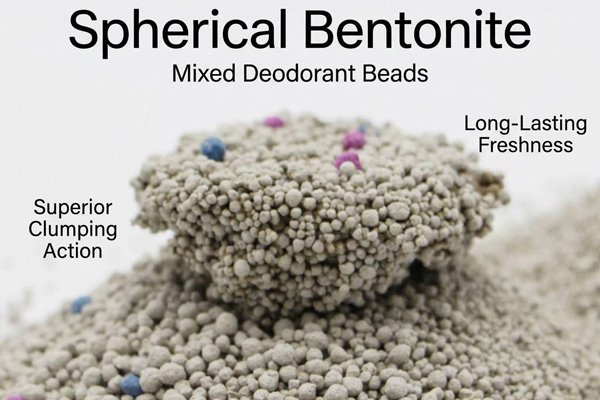
Verification. Three on-site checks. (a) Ask the supplier for the SGS mineral-purity report; the montmorillonite content must be ≥95% (Wyoming-grade sodium bentonite reference). (b) Water-absorption + clumping test — drop the same volume into clear water; genuine sodium bentonite swells fast, forms a tight 5-second rock-hard clump and locks urine ammonia for 30 days; modified bentonite swells slowly, forms a loose clump that breaks on scoop and lets ammonia return within hours. (c) Granule feel — natural sodium bentonite is uniform 1.6–2.5 mm paw-friendly, smooth and slightly oily; acid-activated bentonite feels gritty and leaves visible fines.
Avoidance. Contract clause: specify the Wyoming-grade sodium-bentonite (montmorillonite ≥95%) standard and reject any quote priced meaningfully below industry cost. Each batch must undergo incoming inspection with the supplier’s SGS report attached; rejected batches come back at supplier cost. Emily publishes per-batch SGS montmorillonite certificate, XRD mineral analysis and 200-mesh dust report on every wholesale order.
Reference: ASTM D6400 biodegradable standard (cross-reference for natural-mineral product positioning). Per ASTM standards for mineral product purity, finished pellet montmorillonite must be ≥95% Wyoming-grade sodium bentonite.
Trap 2 — No-Own-Mine Middleman Repackaging Small-Workshop Scraps
Routine + Losses triggered
Routine. Trade middlemen without a sodium-bentonite mining concession or stable ore supply pick up scraps from multiple small workshops, blend and repackage, and claim they are direct from a major plant. When Wyoming-grade ore prices spike, they reformulate ad-hoc with calcium-bentonite or modified bentonite, raise prices last-minute, or delay shipment.
Losses triggered. Batch-to-batch dust, clumping and ammonia-lock vary widely; after-sales complaints climb. Peak-season supply cuts off, the delivery window is missed, and an inferior batch damages the wholesaler’s channel reputation.
Verification + Avoidance
Verification. Ask the supplier for an in-person plant tour photo set, the long-term sodium-bentonite mining concession, the environmental-protection approval document, the complete production ledger and an independent third-party mineral-purity report. Genuine integrated factories run fixed batch numbers with a factory self-inspection sheet per batch; middlemen cannot produce that record trail.
Avoidance. Give the order to a vertically integrated factory that owns its sodium-bentonite ore supply and the full production line — Emily, since 2000, runs the Wyoming-grade montmorillonite supply chain through the granulation and dust-removal line in Dalian, China, with annual output above 300,000+ tons/year, monthly capacity 6,000 MT/month and shipments reaching 80+ countries. Sign a long-term fixed-price supply agreement; do not work with a pure trader who has no mine concession or environmental-approval document.
Reference: Emily bentonite cat litter product page. See the Emily bentonite cat litter product page for the vertically-integrated supply template referenced above.
Trap 3 — Skipped Dust-Removal Process
Routine + Losses triggered
Routine. Small processors cut costs by skipping negative-pressure dust removal and secondary screening. Crushed ore is granulated and bagged directly. Finished-product dust runs well over the standard.
Losses triggered. Cats sneeze from airborne dust; e-commerce platform sampling marks the SKU non-compliant and pulls it from search; offline pet stores refuse to carry the brand long-term and inventory turnover stalls.
Standard reference + On-site test + Avoidance
Standard reference. Per the industry baseline, premium bentonite cat litter dust per scoop (200-mesh sieve) must be < 0.1%.
On-site test. Take a single scoop of litter and rub it between both palms over a black surface. If no thick powder remains in the palm and no visible dust falls on the surface when the litter is shaken lightly, the batch passes. Ask for the supplier’s per-batch 200-mesh sieve SGS report.
Avoidance. Specify hard dust indices at the RFQ stage. Prefer suppliers with complete screening and negative-pressure dust-removal equipment. Build an excess-dust compensation clause into the supply contract; {BRAND} default wholesale contracts include the 200-mesh SGS dust < 0.1% certificate on every batch.
Reference: ISO 17088 compostable plastics standard (cross-reference for product spec). Per ISO 17088 (the international reference for natural-mineral product spec), dust per scoop must be verifiable on receipt.
Trap 4 — Skipped 120–150 Day Natural Curing
Routine + Losses triggered
Routine. High-quality sodium bentonite needs 120–150 days of natural curing to complete the interlayer calcium-ion replacement reaction that gives the granule its swelling and clumping behaviour. To save cost, small workshops shorten the curing cycle to 30–60 days, kiln-dry the granule at high temperature, or skip curing entirely; the granule exits brittle and unstable.
Losses triggered. After long-distance truck or container transportation and multi-layer warehouse stacking, the brittle granule turns to powder and dust. Online customers open the bag to find powder at the bottom; offline pet stores downgrade the SKU; clumping strength drops below 30% in on-site testing and after-sales claims mount.
Verification + Avoidance
Verification. Ask for the supplier’s curing-yard photo set and the production record of the natural-curing cycle. On-site test: drop a single granule five times from 30 cm onto a hard floor. A naturally cured granule shows no break or edge chipping and forms a tight 5-second rock-hard clump; a poorly cured granule shatters or chips visibly and forms a loose clump. Cross-check with the supplier’s per-batch SGS clumping-strength report (target ≥30% clumping strength at 30 seconds, ≥35% at 60 seconds).
Avoidance. Set a pulverization loss upper limit in the contract (typically ≤ 5% over a 30 cm × 5 drop test) and require the supplier to disclose the natural-curing cycle duration (≥120 days) and the curing-yard capacity. {BRAND} runs a 120–150 day natural-curing yard at the Dalian production base and publishes the per-batch curing record.
Trap 5 — Short-Weight Packaging and Incomplete Labels
Routine + Losses triggered
Routine. Small workshops rely on manual filling with no automatic weighing equipment. They deliberately or accidentally reduce the net content per bag; label information is incomplete, photocopied, or missing the destination-market language.
Losses triggered. End consumers complain after weighing, demand a full refund and the store’s reputation is damaged. Market surveillance and e-commerce platform compliance checks pull the SKU from the listing, and inventory becomes stranded.
Verification + Avoidance
Verification. On receipt, randomly re-weigh 10 bags. Net content must fall within the legal tolerance. Check that the label carries the manufacturer’s address, ingredient list, batch number, shelf life, and the local language of the destination market. Per GB/T 43839-2024 (Companion Animal Product Safety), companion-animal product labels must declare ingredient, production date and shelf life.
Avoidance. Prioritize suppliers with automated weighing and metal-detection lines. Specify a net-content compensation clause in the contract: any bag more than 1% under weight triggers a refund or replacement at supplier cost. {BRAND} supports a full range of wholesale packagings — 5 L / 10 L cartons, 5 kg / 10 kg / 20 kg / 25 L bags — with outer options in PP bag, ton bag, carton or unbleached kraft, all recyclable.
Trap 6 — Industrial Fragrance Covering Low-Grade Ore
Routine + Losses triggered
Routine. Low-grade bentonite primary ore has its own pungent odour; the factory does not purify or deodorize, and instead sprays strong industrial fragrance to mask the off-odour and clear inventory before the seasonal peak.
Losses triggered. After high-temperature storage and transportation, the fragrance volatilizes and the sour smell returns. The end consumer notices, complains, and the SKU gets negative reviews; pet-store owners lose trust in the brand and switch to competitors.
Verification + Avoidance
Verification. Seal a sample in a sealed jar and place it in a high-temperature environment (40 °C) for 24 hours; on opening, a high-quality bentonite cat litter retains only a faint natural mineral aroma, no sour or pungent off-note. Ask for the supplier’s SGS fragrance-composition report for any non-Original aroma profile.
Avoidance. Give priority to Original (unscented) bentonite cat litter profiles and verify that any added fragrances are food-grade and within safe dose limits per GB/T 43839-2024. Avoid abnormally low-priced aromatic SKUs whose cost model implies fragrance is doing the covering, not the binding.
Trap 7 — Forced Logistics Bundling and Hidden Freight Premium
Routine + Losses triggered
Routine. The factory deliberately lowers the ex-works quotation to attract orders, then forces the buyer to use their nominated logistics partner at a freight rate well above market. The headline price wins the RFQ; the line-item freight premium recovers the discount.
Losses triggered. Freight premium inflates the landed cost and erodes the wholesale margin. Locked-in logistics also removes the buyer’s ability to optimize for transit time, container routing, or peak-season capacity.
Verification + Avoidance
Verification. Always ask for an itemized quote separating goods, inner packing, outer packing, documentation, freight, insurance and last-mile. Compare three independent freight quotes for the same lane — the gap exposes the embedded premium.
Avoidance. Insist on the right to choose the carrier (or at least three independent quotations). Build an independent-logistics clause into the supply contract and reject any ‘freight inclusive’ pricing that hides the rate. {BRAND} defaults FOB Dalian and quotes EXW / CIF / DDP per lane on request — this gives the buyer carrier optionality from the first RFQ, with a per-batch 20-day dispatch from the Dalian production base.
Reference: EU Fertilising Products Regulation 2019/1009. Wholesale buyers exporting to the EU should also confirm compliance with the EU Fertilising Products Regulation 2019/1009.
Trap 8 — Verbal-Only After-Sales Commitments
Routine + Losses triggered
Routine. Small workshops and individual middlemen make verbal after-sales commitments only — no formal supply contract, no written warranty, no return mechanism, no loss-compensation clause.
Losses triggered. When a batch fails, the supplier denies the verbal commitment; the buyer absorbs the loss, the channel reputation is damaged, and there is no recourse under destination-market consumer law.
Verification + Avoidance
Verification. Refuse to place any order without a signed supply contract that names the warranty period, return mechanism, loss-compensation formula, dispute-resolution jurisdiction and the prevailing standard (industry references for dust, clumping strength and packaging; GB/T 43839-2024 for label / packaging).
Avoidance. Sign a written contract with a vertically integrated supplier — Emily, since 2000, BSIC / ISO 9001 / SGS, Dalian, China — that publishes per-batch SGS montmorillonite certificate, dust (200-mesh) < 0.1% report, clumping-strength report and 72-hour odor-control report; payment by T/T; MOQ 1×20 GP (~18 MT) for both bulk and private label; per-batch 20-day dispatch from the Dalian production base. OEM / ODM / private-label artwork lead time to confirm per SKU.
Frequently Asked Questions
Below are the seven questions wholesale buyers ask most often about bentonite cat litter sourcing. Each answer references the standards, batch-test and contract clauses covered earlier in this guide. Emily’s Dalian production base — since 2000, BSIC / ISO 9001 / SGS, 300,000+ tons/year annual output, 6,000 MT/month, 80+ countries — runs Wyoming-grade sodium-bentonite (montmorillonite ≥95%) standards and per-batch SGS dust (200-mesh) < 0.1%, 1.6–2.5 mm paw-friendly granule, 5-second rock-hard clumps, 30-day ammonia lock, 72-hour odor control, 5% clump breakage. Packaging: 5 L / 10 L cartons + 5 kg / 10 kg / 20 kg / 25 L bags; outer = PP bag, ton bag, carton, unbleached kraft, all recyclable; 18 MT per 20 GP / 22–28 MT per 40 ft HC bulk. Incoterms default FOB Dalian; EXW / CIF / DDP quoted per lane; payment by T/T; MOQ 1×20 GP (~18 MT) for both bulk and private label; per-batch 20-day dispatch; OEM / ODM / private-label artwork lead time to confirm per SKU. Sample flow adjusted by buyer segment (small wholesalers, OBM operators, OEM/private-label brands, large catteries / shelters).
Q1. Can you be allergic to cat litter?
Yes, some cats and humans react to dust, fragrance or additives in cat litter. Bentonite cat litter at < 0.1% dust per scoop (200-mesh sieve) and Original (unscented) profile typically triggers fewer reactions than higher-dust or fragranced alternatives. For sensitive cats, ask the supplier for an SGS dust + fragrance-composition report per batch.
Q2. Is cat litter toxic?
High-quality bentonite cat litter (SGS certified, montmorillonite ≥95%) is non-toxic to cats. It contains no formaldehyde and no heavy metals above limit. Always check the per-batch SGS report — including the 200-mesh dust < 0.1% certificate — before shipping to a channel serving kittens, seniors, or cats with respiratory sensitivity.
Q3. How often to change cat litter?
Standard household practice is to scoop clumps daily and refresh the tray every 7–14 days depending on the number of cats, the ventilation and the dust tolerance. For multi-cat households, a second tray reduces ammonia build-up and improves clumping consistency.
Q4. What is cat litter made of?
High-quality bentonite cat litter is made from 100% natural Wyoming-grade sodium bentonite (montmorillonite ≥95%). Avoid SKUs that contain acid-activated calcium bentonite or modified bentonite — these are the marker materials for Trap 1 of this guide. Ask for the supplier’s per-batch SGS montmorillonite certificate before contracting.
Q5. Can you flush cat litter?
Bentonite cat litter is NOT flushable. The sodium-bentonite granule does not disperse in water; flushed clumps can settle in drain pipes and septic tanks, causing blockages. Dispose of used clumps in household waste. For a flushable alternative, consider plant-based cat litter; verify with the supplier’s SGS water-dispersibility report before recommending it to the channel.
Q6. Why is cat litter so expensive?
Bentonite cat litter controls odor through sodium-bentonite ammonia adsorption, not by masking. High-quality profiles with ≥95% Wyoming-grade montmorillonite lock urine ammonia for 30 days without added fragrance. For channels serving odor-sensitive consumers, favour Original (unscented) and avoid aromatised SKUs whose fragrance is doing the covering, not the binding.
Q7. How to get rid of cat litter?
Bentonite cat litter controls odor through sodium-bentonite ammonia adsorption, not by masking. High-quality profiles with ≥95% Wyoming-grade montmorillonite lock urine ammonia for 30 days without added fragrance. For channels serving odor-sensitive consumers, favour Original (unscented) and avoid aromatised SKUs whose fragrance is doing the covering, not the binding.