




النقاط الرئيسية
- يستحوذ رمل القطط الطيني على أكثر من 60% من سوق رمل القطط العالمي لأن ملمس الحبيبات يحاكي رمال الصحراء التي تطورت عليها القطط - أكثر من 90% من القطط تقبل رمل الطين بشكل غريزي.
- المعدن النشط هو المونتموريلونيت، وهو سيليكات طبقي يتمدد بمقدار 15 ضعفًا عند ملامسته للماء، مما يؤدي إلى حبس البول في كتل صلبة وسريعة.
- Sodium-based clay (not calcium-based) is what delivers premium performance: hard clumps, fast water-lock, minimal crumbling. Always check the label for ‘Sodium Bentonite’.
- Odor control in clay cat litter is physical adsorption, not perfume masking — montmorillonite’s cation exchange capacity (80–150 meq/100g) traps ammonia molecules at the molecular level, with zero fragrance burden on a cat’s respiratory system.
- Dust is the hidden health risk. Low-grade clay cat litter throws fine PM2.5 particles linked to feline chronic bronchitis and pulmonary fibrosis. Quality sodium bentonite controls dust to under 1% through multi-stage dedusting.
- The real cost metric is monthly consumption per cat, not unit price. High-quality sodium bentonite clay litter lasts 3–4 weeks per bag in a multi-cat home — more than double the lifespan of tofu litter, which disintegrates and needs full replacement weekly.
- Every litter type has trade-offs. Clay is mineral-based (not flushable, but crustal reserves exceed 25 billion tons). Tofu consumes food crops. Crystal relies on energy-intensive synthesis. There is no ‘zero-burden’ option — only informed choice and sealed-bin disposal.
Clay Cat Litter Comparison Table: Sodium vs. Calcium
| الميزة | Sodium Bentonite (Premium) | Calcium Bentonite (Low-Grade) |
| Expansion ratio | 15×+ original volume | 3–5× original volume |
| Clumping hardness | Hard, holds shape when scooped | Soft, crumbles easily |
| Water-lock ability | Excellent — no urine pooling at tray bottom | Poor — urine leaks, whole tray spoils |
| مستوى الغبار | <1% (multi-stage dedusted) | 3–8% (visible dust cloud on pour) |
| Odor adsorption | High CEC (80–150 meq/100g) | Low CEC — relies on added fragrance |
| Lifespan per bag | 3–4 weeks (multi-cat) | 1–2 weeks |
| Label identifier | “Sodium Bentonite” clearly marked | Vague or unlabeled — “bentonite” only |
| Recommendation | Buy this | Avoid |
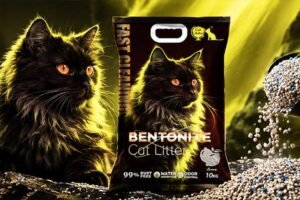
Walk into any pet store in North America or Europe and you will see bags of grey clay cat litter on the shelves. It looks simple — no plant-fibre elegance, no crystal-bead futurism — yet clay-based litter commands over 60% of the global cat litter market. The reason is straightforward: when it comes to cat instinct, simplicity usually means correctness. This guide unpacks clay cat litter across four dimensions — geology, user experience, economics, and smart selection — so you can decide with confidence.
Who this clay cat litter guide is for
هذا مناسب لك إذا: you own one or more cats and want to understand why clay cat litter remains the market leader — or you have tried tofu or crystal litter and your cat rejected it.
لا يناسبك إذا: you need industrial-volume sourcing for a large cattery — that is a wholesale conversation and belongs on the catglobal bulk cat-litter wholesale page.
With over 60% global market share, clay cat litter is not a legacy product holding on — it is the litter type most cats accept on instinct. Getting the litter choice right saves you money, odour stress, and vet visits every single month.
Why Cats Choose Clay: The Desert Instinct
Before domestication, cats lived in the deserts of North Africa and the Middle East for tens of thousands of years. Soft, fine sand was their natural excretion medium — the sensation of paws sinking in, the instinctive action of digging and burying. That genetic memory is alive in every domestic cat today.
This is why many cats reject tofu litter (wrong texture underfoot) or crystal litter (no digging satisfaction). Clay cat litter granules replicate that desert surface precisely: fine as dust but non-airborne, soft enough to paw through yet cohesive enough to clump instantly. When you choose clay, you are not choosing a product — you are offering your cat a small patch of territory that matches its genetic blueprint.
Inside Montmorillonite: The Physics of 3-Second Clumping
The core component of premium clay cat litter is montmorillonite, a naturally occurring layered silicate mineral first identified in Fort Benton, Wyoming. Picture its microstructure as a stack of nano-scale playing cards. When water molecules enter the gaps between layers, the lattice spacing expands to several times its original thickness — and a high-quality montmorillonite particle can swell to over 15× its original volume on contact with liquid.
Simultaneously, a gel-like barrier forms on the particle surface. This is the physics behind clay’s 3-second clumping: urine contacts the granule → lattice expands to lock water → gel layer binds adjacent particles → a compact, non-crumbling, non-sticky clump forms instantly. One scoop, and the tray is clean — no ‘urine pool’ at the bottom, surrounding granules stay dry and reusable.
Sodium vs. calcium bentonite: the critical distinction
The industry rarely spells this out, but sodium bentonite and calcium bentonite are fundamentally different materials. Sodium-based bentonite’s expansion ratio is several times that of calcium-based, and its clumping hardness and water-locking capacity are far superior. Some low-priced ‘bentonite’ clay cat litters cut costs by blending in calcium-based clay — the result is loose clumps that break apart when scooped, urine leaking to the tray bottom, and a whole tray of wasted litter. If the product page does not clearly state ‘sodium-based’ or ‘Sodium Bentonite,’ proceed with caution.
For a deeper look at the Wyoming-grade montmorillonite supply and the per-batch SGS dust report that catglobal ships with every wholesale order, see the catglobal sodium bentonite clay cat litter product page. For the broader mineral taxonomy and CEC measurement, the ISO 11264 soil-quality cation exchange capacity standard is the international reference.
Odour Control: Physical Adsorption, Not Perfume Masking
A common industry shortcut for odour control is drowning the problem in strong artificial fragrance — lavender, lemon, ocean breeze. It smells pleasant to humans, but for cats it is a disaster. Cats have roughly 14× the olfactory receptor cells that humans do. Strong synthetic scents amount to continuous olfactory bombardment, and worse, the moment the fragrance evaporates, ammonia odour rebounds. The result: lavender-scented ammonia — more pungent, and fooling no one.
Clay cat litter takes a different route: physical adsorption. Montmorillonite’s layered structure carries natural cation exchange capacity (CEC), ranging from 80 to 150 milliequivalents per 100 grams. Ammonia molecules carry a positive charge. When they enter the mineral lattice, negative charges within the layers capture and immobilize them — sealing the odour at its source. No chemical reaction, no fragrance release, zero burden on your cat’s respiratory tract and paw pads. You cannot smell it, and your cat is not suffering through it.
Dust: The Underestimated Health Risk
Every cat owner knows that moment — pour the litter, a white cloud rises, and both human and cat start sneezing. This is not minor. Fine PM2.5-level dust particles in low-grade clay cat litter enter a cat’s lower respiratory tract directly. Long-term exposure is linked to chronic bronchitis and, in severe cases, pulmonary fibrosis.
The more hidden risk lives inside the litter tray itself. When a cat paws and digs, dust stirred up stays suspended in the confined tray space. Every time the cat lowers its head to bury waste, it inhales a nose-full of mineral particulates.
Quality sodium bentonite clay cat litter controls the dust rate to under 1% through multi-stage dedusting and particle-shaping technology. A quick home test: grab a handful of litter, spread it on black paper, pat with your palm, remove your hand, and look at the paper. Good litter leaves almost no trace. For an even more intuitive check, pour into a black litter tray — the tray bottom should stay clean, with no grey powder settling.
The Real Cost: Monthly Expense Beats Unit Price
Tofu litter can look cheaper per bag, but recalculated by monthly usage cost, the picture shifts. Tofu litter disintegrates after absorbing moisture — to prevent bacterial growth, a full tray replacement every week is standard practice. Clay cat litter, by contrast, only clumps and does not spread. Daily maintenance means scooping out clumps and topping up a small amount of fresh litter.
One bag of high-quality sodium bentonite clay litter lasts 3 to 4 weeks in a multi-cat household — more than double the service life of tofu litter. For a multi-cat home or a small cattery, the annual cost difference is substantial. The metric that matters is not the price tag on the bag — it is the actual consumption in grams per cat per month. Distributors comparing catglobal’s per-tonne wholesale clay cat litter pricing can use grams-per-cat-per-month as the common denominator across SKUs.
The Environmental Question: A Balanced Look
Clay cat litter faces two recurring criticisms: it cannot be flushed down the toilet, and it is a non-renewable mineral. Both points deserve a closer look.
On flushability
Yes, clay swells into mud on contact with water and poses a blockage risk in plumbing. However, the ‘flushable’ claim of tofu litter also comes with caveats — small batches only, caution with old pipes, not recommended for septic systems. The truly responsible disposal method for any litter type is sealed disposal into the urban waste management system. Treating ‘flushable’ as an environmental badge may be a marketing-shaped illusion.
On renewability
Montmorillonite is indeed a mined mineral resource, but crustal reserves are vast. Global proven bentonite reserves exceed 25 billion tons — enough to supply centuries of production at current extraction rates. By comparison: tofu litter consumes food crops (peas, corn), and crystal litter depends on energy-intensive chemical manufacturing. Every option carries an environmental cost. The goal is not to find a perfect ‘zero-burden’ solution — none exists — but to make an informed choice with full awareness of the trade-offs.
How to Choose Clay Cat Litter by Household
Multi-cat homes
Prioritize sodium-based clay cat litter with high CEC (80+ meq/100g). More cats mean more urine, so clumping speed and water-lock capacity are the top two criteria. Avoid calcium-based blends — they will fail under multi-cat load within days.
Small apartments and rentals
Choose a low-dust (<1%) sodium bentonite. If you cannot tolerate airborne particles in a compact living space, dust-controlled clay cat litter combined with daily scooping outperforms tofu litter on odour containment without the mould risk in humid bathrooms.
First-time cat owners
Start with a well-reviewed sodium bentonite clay cat litter brand. It has the highest cat acceptance rate, which removes the biggest variable — a cat that refuses the box entirely. Reassess after three months.
On a budget
A mid-grade sodium bentonite paired with activated-carbon deodorising beads keeps monthly spend low while maintaining odour control. Avoid calcium-based impostors — the short-term savings vanish once you factor in full-tray replacements every week.
How to Switch to Clay Cat Litter Safely
Never swap everything at once. Cats are strongly scent-sensitive, and a sudden litter change is one of the most common triggers for box refusal. Follow the 7-day graduated switch:
- Days 1–2: Mix 20% new clay cat litter into the existing litter.
- Days 3–4: Raise to 50% new litter.
- Days 5–6: Raise to 80%.
- Day 7: 100% new clay litter.
Watch your cat’s behaviour at each stage. If it hesitates or protests, slow the transition by holding at the current ratio for an extra two days.
Three Mistakes to Avoid When Buying Clay Cat Litter
1. Buying unlabeled ‘bentonite’ without checking sodium vs. calcium
If the packaging does not explicitly state ‘Sodium Bentonite,’ assume it is calcium-based or a calcium-heavy blend. The clumps will be loose, the odour control weak, and the cost-per-use higher because you will replace the whole tray more often.
2. Choosing scented clay litter
Fragranced clay cat litter is a red flag — it usually signals low-grade calcium-based clay that cannot control odour through adsorption alone, so it masks the problem with perfume. A cat’s nose is ~14× sharper than a human’s. Skip scented litter and buy sodium bentonite with high natural CEC instead.
3. Ignoring the dust test
Never trust the ‘low-dust’ claim on the package without verifying. Open the bag, pour a scoop onto dark paper, pat, and check for residue. If visible dust clouds rise or fine powder settles, return the product regardless of price — your cat’s respiratory health is not worth the discount. On feline respiratory health and dust irritants, the مركز كورنيل لصحة القطط is a trusted reference for how airborne particles affect cats over time.
Clay cat litter care and how often to replace it
Scoop clumps once or twice daily and do a full litter change plus tray wash every week. Even the best sodium bentonite clay cat litter should be fully replaced weekly — leftover soiled litter breeds bacteria that can lead to feline urinary tract infections. Maintain a litter bed depth of at least 5 cm so your cat can dig and cover naturally.
الأسئلة الشائعة
Quick answers to the questions cat owners ask most when choosing or switching to clay cat litter.
Q1. What is clay cat litter?
Clay cat litter is any litter made from granulated natural clay — most commonly sodium bentonite, a layered silicate mineral (montmorillonite) mined in Wyoming, the U.S., and several other regions. Quality clay cat litter expands 15× on contact with liquid, locks urine into a hard clump, and uses the mineral’s natural cation exchange capacity (80–150 meq/100g) to adsorb ammonia physically — no fragrance required. It holds roughly 60% of the global cat litter market because the fine-granule texture matches the desert sand cats evolved on, and 90%+ of cats accept it on instinct.
Q2. How often should you change clay cat litter?
Scoop clumps once or twice a day and do a full litter change plus tray wash every week. Even premium clay cat litter should be fully replaced weekly — leftover soiled litter breeds bacteria that can lead to feline urinary tract infections. Keep the bed at least 5 cm deep so your cat can dig and cover naturally. Daily scooping extends bag life to 3–4 weeks per multi-cat household.
Q3. Can you flush clay cat litter?
No. Clay cat litter — including sodium bentonite — swells into mud on contact with water and will block pipes. Dispose of used litter sealed in the regular household waste bin. Even ‘flushable’ litter types should only be flushed in very small amounts with caution; the safest universal practice is sealed bin disposal for every litter type, including clay-based formulas.
Q4. Is clay cat litter toxic to cats?
Low-grade clay cat litter with poor dust control is the actual concern. Fine PM2.5 particles in un-de-dusted clay litter enter a cat’s lower respiratory tract directly and are linked to chronic bronchitis and, in severe cases, pulmonary fibrosis with long-term exposure. Premium sodium bentonite controls dust to under 1% through multi-stage dedusting. Always do the black-paper dust test before committing to a brand.
Q5. Is clay cat litter bad for the environment?
Every litter type has an environmental cost. Clay cat litter is a mined mineral, but global proven bentonite reserves exceed 25 billion tons — enough for centuries at current extraction rates. By comparison, tofu litter consumes food crops (peas, corn), and crystal litter requires energy-intensive chemical synthesis. The bonus with clay: a 3–4 week bag lifespan in a multi-cat home means less packaging and transport per cat per year than the alternatives.
Q6. What is the best clay cat litter for multi-cat homes?
For multi-cat homes, prioritize sodium-based clay cat litter with high cation exchange capacity (CEC 80+ meq/100g), a stated dust rate under 1%, and a clearly labelled ‘Sodium Bentonite’ on the bag. The clumping speed and water-lock capacity of sodium bentonite handle multi-cat urine load without the tray bottom spoiling. catglobal’s low-dust sodium bentonite clay cat litter hits these specs and ships in 5 L / 10 L cartons or 5 kg / 10 kg / 20 kg / 25 L bags for wholesale.
Q7. Can you be allergic to clay cat litter dust?
Yes — the dust in low-grade clay cat litter, not the clay itself, is the usual trigger. Fine mineral particles carry trace proteins and irritants that can provoke sneezing, itchy eyes, or asthma-like symptoms in both cats and their owners. The fix is to choose a premium sodium bentonite clay litter with a stated dust rate under 1% and multi-stage dedusting, and to scoop in a ventilated space. If symptoms persist, consult an allergist and a feline veterinarian.