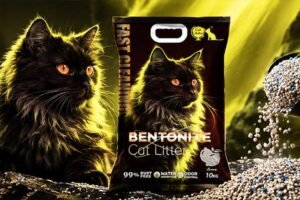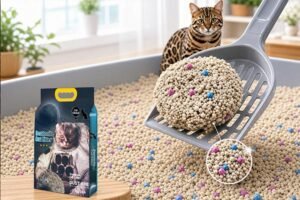




A walkthrough of every step that turns raw sodium bentonite into a bag of Cat Global bentonite cat litter — from raw-material intake through dust extraction, fragrance loading, OEM customisation, and final QC.
Need the spec floor first? See the sodium bentonite spec guide. For the buyer’s perspective, see the bulk B2B buying guide.
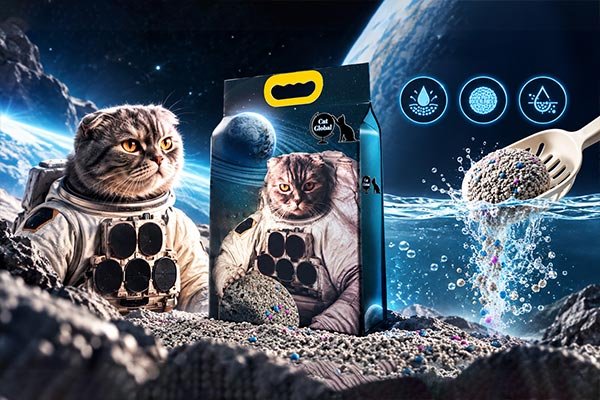
1. The Aisha-Pet factory — production base
Cat Global bentonite cat litter is produced at Aisha-Pet — the in-house factory of PY-PET (Puyuan Dalian Pet Products Co., Ltd.) in Dalian, China. Aisha-Pet sits on an 18,000 m² integrated facility in the Dalian Economic & Technological Development Zone, operates 12 production lines, and runs at 6,000 tons / month total capacity across all substrates. The bentonite line occupies 4 of the 12 lines.
The factory is the same legal entity as the Cat Global brand owner — PY-PET is the company, Aisha-Pet is its factory name, Кэт Глобал is its customer-facing brand. One company, one factory, one quality system.
2. The bentonite production line — 7 stages
2.1 Stage 1 — Raw-material intake and screening
Sodium bentonite arrives at Aisha-Pet in 1 MT bulk bags or 25 kg sacks, sourced from Wyoming-grade sodium-bentonite mines. Each shipment is sampled and tested on arrival for:
- Swelling index — must be ≥ 12× dry volume (rejection band: < 10×)
- Влага — must be ≤ 12% on arrival (rejection band: > 15%)
- Heavy metals — SGS-tested against the Cat Global spec (Pb ≤ 5 mg/kg, As ≤ 2 mg/kg, Cd ≤ 1 mg/kg)
- Visual inspection — no off-color clay, no contamination
Approved raw material moves to the climate-controlled silo (≤ 25°C, ≤ 70% RH). Rejected batches are returned to the supplier with the test report.
2.2 Stage 2 — Crushing and granulation
The raw bentonite is fed into a jaw crusher (for the initial size reduction) followed by a roll crusher (for the target granule shape). The crushed bentonite is screened into the three standard shapes — round (1.6–2.5 mm), ball (2.0–3.0 mm), crushed (1.5–4.0 mm). Custom shapes for OEM programs are run on the same line with a swapped screen pack.
Granule size distribution is checked in-process every 30 minutes via laser-diffraction particle sizer. Out-of-spec material is recycled back into the crusher feed.
2.3 Stage 3 — Dust extraction (the critical step)
This is the step that turns value-tier bentonite (2–3% dust) into premium low-dust bentonite (≤ 0.5% dust). The crushed bentonite passes through a multi-stage cyclone dust-extractor — air is drawn through the granule stream and the < 75 μm dust fraction is separated and collected for off-spec use (industrial absorbents, etc.).
Cat Global’s dust-extraction system targets ≤ 0.5% residual dust on the final product. After the cyclone, the granule stream passes through a vibrating-deck fines separator for a final pass. In-line laser particulate counter measures the dust fraction every 15 minutes.
2.4 Stage 4 — Fragrance loading
For scented SKUs, fragrance oil is sprayed onto the bentonite granules in a rotating mixer. Fragrance load is tuneable between 0.05% and 0.40% depending on SKU. The 8 stock fragrances (Unscented / Apple / Lemon / Lavender / Rose / Green Tea / Coffee / Baby Powder) are pre-mixed in 200 L drums; the spray rate is calibrated per SKU.
Custom fragrance profiles (ocean breeze, white musk, jasmine, mango) are available for OEM programs above 5 MT per SKU. Fragrance load is verified every batch via gas chromatography on the in-house QC lab.
2.5 Stage 5 — Packaging
The finished bentonite is packed via automated weigh-fill-seal lines into the configured pack size:
- 5 kg pack — PE inner bag + Kraft paper outer, 4 bags per master carton
- 10 kg pack — PE inner bag + Kraft paper outer, 2 bags per master carton
- 20 kg pack — PE inner bag + woven PP outer, single-bag (no master carton)
- 5 L / 10 L / 25 L pack — PE inner bag + printed woven outer (or printed PE for shelf)
- Custom OEM pack — printed PE / Kraft / woven to buyer spec
Pack-weight tolerance: ± 1% (Cat Global QC spec). Seal-integrity check on every bag via pressure-decay test. Master cartons are labelled with SKU code, batch number, production date, and expiry date.
2.6 Stage 6 — Palletisation (optional)
For shelf-ready delivery or container-optimised shipping, finished cartons can be palletised on fumigated ISPM-15 wooden pallets (1.0 × 1.2 m standard) with shrink-wrap. A standard pallet holds 800 – 1,200 kg of finished bentonite depending on pack size.
Palletised containers load approximately 5% more efficiently than loose cartons because of the better cube utilisation.
2.7 Stage 7 — Container loading, documentation, and dispatch
The finished pallets or loose cartons are loaded into 20FT or 40HQ containers. Loading is done under cover to prevent rain ingress. On the day of FOB Dalian, the buyer receives:
- Loading photo (with timestamp + container number)
- Container number
- COA (Certificate of Analysis — per batch)
- SGS test report (third-party)
- MSDS (Material Safety Data Sheet)
- COO (Certificate of Origin — for tariff preference)
- Health Certificate (issued by CIQ)
- Fumigation Certificate (when palletised)
- Commercial Invoice + Packing List
- Regional add-ons: ANVISA / MERCOSUR / GSO / GCC / FDA Philippines as required
3. In-process QC checkpoints
| Stage | QC check | Frequency | Method |
|---|---|---|---|
| Raw intake | Swelling index, moisture, heavy metals | Every shipment | In-house + SGS |
| Post-crush | Granule size distribution | Every 30 min | Laser diffraction |
| Post-dust-extraction | Dust content | Every 15 min | Laser particulate counter + 200-mesh sieve |
| Post-fragrance-load | Fragrance load % | Every batch | Gas chromatography |
| Post-pack | Pack weight + seal integrity | Every bag | Weigh-scale + pressure-decay test |
| Final batch | Clumping strength, deodorisation, dust, heavy metals | Every batch | SGS third-party |
Every batch retains a 1 kg reference sample for 12 months post-shipment. If the buyer reports a quality issue, the reference sample can be re-tested to confirm whether the issue was batch-specific or post-shipment contamination.
4. OEM customisation workflow
For OEM buyers (private-label programs, shelf-ready packs, custom fragrance profiles), the production line accepts the following customisation parameters:
| Customisation | Минимальный объем заказа | Lead time impact |
|---|---|---|
| Custom artwork on outer pack | 1 × 20FT | + 5 – 8 days (printing plate changeover) |
| Custom fragrance profile | 5 MT per SKU | + 10 – 14 days (fragrance sourcing + GC calibration) |
| Custom granule shape | 5 MT per SKU | + 7 – 10 days (screen-pack tooling) |
| Custom fragrance load % | 1 × 20FT | + 2 – 3 days (spray calibration) |
| Custom pack size (non-standard) | 1 × 20FT | + 7 – 14 days (bag-production tooling) |
| Custom master carton design | 1 × 20FT | + 5 – 8 days (carton tooling) |
For OEM customisation beyond the stock specifications, Cat Global’s design team handles layout, translation and back-panel compliance free of charge for OEM programs above 1 × 20FT.
5. The 5-step OEM process (buyer side)
For the buyer’s perspective, the OEM process is the same 5 steps used by Cat Global’s existing partners:
- Submit your brief — target market, shelf price tier, granule shape, fragrance profile, fragrance load, pack format, destination-market documentation. (Day 0–2)
- Sample + formula lock — 5–10 kg free sample, freight collect. Iterate on clumping, fragrance throw, dust level, granule feel. Lock in writing. (Day 3–14)
- Artwork + packaging design — send your your artwork or use our free in-house design service. 3D mock-up + printed-on-bag proof + translated back-panel compliant with destination market (ANVISA, GSO, MERCOSUR, GCC). (Day 10–18)
- Production + third-party QC — production on a dedicated line, in-process QC at every stage. SGS dust + heavy-metal + swelling-index testing on the final batch before shipping. (Day 18–32)
- Ship + documentation — loading photo + container number + full document set (COA, MSDS, COO, SGS report, Commercial Invoice, Packing List) sent on the day of FOB Dalian. CIF / DDP quoted per destination lane. (Day 32+ · ≤ 20 days after deposit)
End-to-end OEM program duration: 32–40 days total. Standard SKU lead time: ≤ 20 days after deposit.
6. What a factory tour looks like
B2B buyers are welcome to visit the Aisha-Pet factory for an in-person tour. The standard tour takes 3–4 hours and covers:
- Raw-material warehouse (sodium bentonite silos + sample library)
- Production line walkthrough (crusher → dust extractor → fragrance loader → pack line)
- In-house QC lab (laser particle sizer, gas chromatograph, 200-mesh sieve station)
- Finished-goods warehouse (climate-controlled, batch-tracked)
- Loading dock (container-loading observation, optional)
- Export documentation review (COA / SGS / COO samples from recent shipments)
Tours are scheduled with 2 weeks’ notice. Buyers are paired with their dedicated account manager for the visit. Send your preferred dates via the inquiry form and we’ll book the visit.
7. Capacity and scaling
Aisha-Pet operates 4 dedicated bentonite production lines, with total bentonite capacity of approximately 1,800 – 2,200 MT / month (vs the 6,000 T/month factory total across all substrates). Peak season (October – February for the Middle East and South America buying cycles) runs at ~ 90% utilisation; off-peak runs at ~ 60%. This headroom means new-buyer 20FT pilots can typically be scheduled within 14 days of deposit.