




Not all bentonite is created equal. Sodium bentonite and calcium bentonite look the same in the bag but behave completely differently in the litter box. This guide helps B2B buyers pick the right grade — and avoid the most common substitution trap.
Need the buyer’s perspective first? See the bulk B2B buying guide. For the full spec deep-dive, see the sodium bentonite spec guide.
1. Why the grade matters — and why buyers get tricked
B2B buyers searching for bentonite cat litter manufacturer, bentonite cat litter factory, wholesale bentonite cat litter, or bulk bentonite cat litter usually assume there is one product called “bentonite cat litter”. There are two — sodium bentonite (clumping grade) and calcium bentonite (absorbent grade) — and they behave completely differently. The price difference between them (typically 15–25% lower for calcium) is the bait; the difference in clumping is the trap.
Cat Global ships sodium bentonite only — because we sell clumping cat litter and only sodium bentonite clumps. This guide explains what each grade does, why the substitution happens, and how to verify the grade on every shipment.
2. Side-by-side comparison
| Axis | Sodium bentonite (Cat Global) | Calcium bentonite (non-clumping) |
|---|---|---|
| Склеивание | Yes — rock-hard, 3 seconds | No — absorbs liquid but does not form a scoopable clump |
| Swelling index | 12 – 15× dry volume | 3 – 6× dry volume (limited expansion) |
| Sweeping mechanism | Sodium ions in clay absorb water; platelets expand and lock liquid | Absorbs liquid into porous structure; no platelet expansion |
| Deodorisation | 88 – 92% (cation-exchange locks ammonia) | 50 – 70% (absorption only, no chemical lock) |
| Dust content (Cat Global spec) | ≤ 0.5% (low-dust grade) | 1.5 – 3.0% (higher inherent dust) |
| pH | 8.5 – 9.5 (typical bentonite range · cat-safe) | 6.0 – 8.5 (more neutral) |
| Bulk density | 0.75 – 0.88 g/ml (heavy) | 0.55 – 0.75 g/ml (lighter) |
| Per-ton FOB Dalian | Mid (premium clumping grade) | Low (15–25% cheaper than sodium) |
| Best shelf tier | Multi-cat households, clumping positioning | Non-clumping positioning (rare in modern shelf programs) |
| Best markets | Global — 95%+ of clumping cat litter sold globally | Specialty absorbent litter programs (rare) |
3. The clumping question — why only sodium works
The clumping reaction is what makes sodium bentonite irreplaceable for modern cat litter. Here’s the chemistry in plain language:
- Бентонит натрия has sodium ions sitting between the clay platelets. When water hits the clay, the sodium ions hydrate and the platelets push apart — the clay expands 12–15× its dry volume, locking liquid inside the expanded structure. The result is a rock-hard clump.
- Calcium bentonite has calcium ions sitting between the platelets instead. Calcium is divalent (carries a 2+ charge), so it binds the platelets more tightly. Water can’t pry them apart — the clay absorbs liquid into its porous structure but doesn’t expand or clump.
There is a hybrid grade called sodium-activated calcium bentonite — calcium bentonite treated with sodium carbonate to push some sodium ions onto the platelet surfaces. This gives partial clumping (5 – 8× swelling, weak clumps) but is not a substitute for true sodium bentonite. Some factories sell it as “sodium bentonite equivalent” at a discount. The COA will reveal the truth — always check the swelling index, not the label.
4. The substitution trap — how it happens
The substitution trap works like this:
- You (the buyer) request a quote for “sodium bentonite cat litter” from 3 suppliers. Supplier A quotes USD 280 / MT; Supplier B quotes USD 245 / MT; Supplier C quotes USD 220 / MT.
- Supplier C’s price looks attractive — 21% below A.
- You place the order with C. The first 2 shipments pass your basic QA. The third shipment fails: 12 customer complaints about clumps breaking during scooping.
- You send samples back to a third-party lab. The COA shows swelling index 6×, not 12×. The shipment is calcium bentonite, not sodium bentonite. Supplier C substituted partway through the contract.
This is the most common quality fraud in bentonite cat litter — and it happens because the substituted material looks identical to the human eye and only the swelling test reveals the difference. Always require a written COA with swelling index ≥ 12× per shipment. If the supplier refuses, walk away.
5. The deodorisation question — why calcium underperforms
Sodium bentonite’s deodorisation comes from its high cation-exchange capacity (CEC) — the clay surface has many negatively charged sites that attract positively charged ammonia (NH₃) and trimethylamine (the fishy smell). The ammonia gets locked onto the clay surface and stays there.
Calcium bentonite has lower CEC (calcium holds the binding sites more tightly), so it absorbs odours physically but doesn’t chemically lock them. In a multi-cat household, calcium bentonite smells within hours; sodium bentonite stays neutral for 24–72 hours.
6. The dust question
Both grades have similar dust behaviour in raw form — it’s the granulation and dust-removal step that determines final dust content. Cat Global dust-extracts both incoming sodium and calcium bentonite to ≤ 0.5%, but calcium bentonite’s softer platelet structure means the dust content creeps back up during storage (3–6 months in a sealed bag). Sodium bentonite’s harder platelet structure holds the dust-removal longer.
For long-shelf-life distribution (12+ months in the bag), sodium bentonite is the safer choice.
7. The price question — when calcium is actually the right call
Calcium bentonite is not always the wrong answer. There are three scenarios where calcium bentonite is genuinely the right product:
- Non-clumping positioning — some buyers target the non-clumping segment (typically older cat owners who prefer to fully replace the litter weekly). This is a small niche in most markets but exists.
- Absorbent + odor-control floor litter — some buyers layer calcium bentonite as the floor of the box and use a thin sodium-bentonite layer on top for clumping. Hybrid programs work.
- Industrial absorbent applications — workshops, garages, agricultural settings where cat litter is used as a generic absorbent. Calcium bentonite is fine here.
For B2B cat-litter distribution in shelf packaging, sodium bentonite is the only grade that makes commercial sense. If a supplier offers you “bentonite cat litter” without specifying the grade, ask which one — and require it on the COA.
8. How to verify the grade on arrival
Three tests every B2B buyer should run on every shipment:
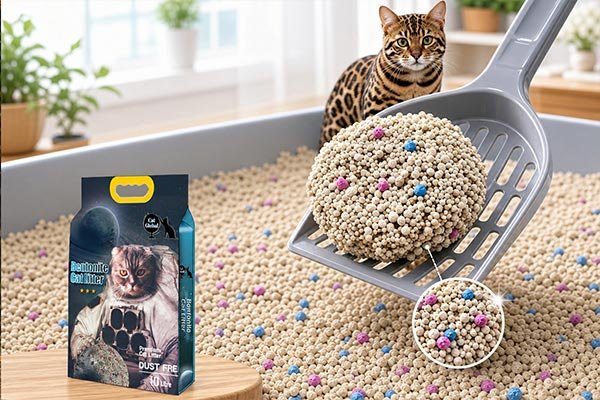
- Visual clump test — pour 30 ml of water onto 200 g of litter in a bowl. Wait 30 seconds. Scoop the clump with a spoon. If the clump holds together (rock-hard, no crumbling), it’s sodium bentonite. If it dissolves or crumbles, it’s calcium or sodium-activated calcium.
- Swelling index test — measure 10 ml of dry litter into a 250 ml graduated cylinder. Add 200 ml of water. Wait 24 hours. Read the new volume. Divide by 10 ml. If the ratio is ≥ 10×, it’s sodium bentonite. If it’s 3 – 6×, it’s calcium.
- COA check — every shipment should arrive with a Certificate of Analysis listing swelling index. If the supplier can’t produce a COA per batch, find a new supplier.
9. Cat Global’s position
Cat Global ships sodium bentonite only. Every shipment includes:
- COA with swelling index ≥ 12× (per batch)
- SGS third-party test report (per shipment)
- Heavy-metal report (Pb ≤ 5 mg/kg, As ≤ 2 mg/kg, Cd ≤ 1 mg/kg)
- MSDS, Packing List, Commercial Invoice
If a buyer specifically requests calcium bentonite (for the non-clumping niche scenarios above), Cat Global can source it — but we’ll always recommend sodium bentonite first and explain why.
10. The one-page decision summary
| Question | Answer |
|---|---|
| Which grade clumping? | Sodium bentonite only |
| Which grade Cat Global ships? | Sodium bentonite only |
| Why is calcium bentonite cheaper? | No clumping reaction → lower production cost → lower price |
| How to detect a substitution? | COA swelling index test — must be ≥ 12× |
| When is calcium bentonite the right choice? | Non-clumping positioning, hybrid absorbent floor, industrial absorbent |
| What is the per-ton FOB Dalian difference? | Sodium ≈ +15 – 25% over calcium |
| Which grade does the B2B shelf market globally want? | Sodium — 95%+ of modern clumping cat litter sold globally |